BuddyBoss Alternative: TribeCrafter vs BuddyBoss (2026)

Introduction
If you run a community on BuddyBoss, you already know the pattern. An update goes out and something on your site breaks. The feed slows down just as your membership starts to grow. A renewal invoice arrives and it's higher than the price you remember signing up for. Somewhere along the way, you became the person who fixes all of it, whether or not you ever wanted that job.
BuddyBoss's pricing page leads with a simple number: web plans from $199 for the first year. That number is the start of the bill, not the end of it. The Launch plan renews at $399 in year two, and Scale goes from $349 to $699. The mobile app is a second subscription, from $499 to $2,999 in its first year, and it has its own jump at renewal. Then come the things BuddyBoss doesn't sell you: a course plugin, often a membership plugin, hosting, and a developer for the days an update breaks something. Nobody adds all of that up in one place for you.
You don't need that many moving parts to run a serious community. TribeCrafter is one hosted platform with the feed, groups, courses, events, blog, member directory, 1:1 chat and selling built in. You pay 0% platform fees on every plan, and our team moves your members over from BuddyBoss as part of every plan, at no extra cost.
This guide walks through what BuddyBoss actually costs, why it gets slower and harder to run as a community grows, and what changes if you move to TribeCrafter. We've tried to keep it fair: BuddyBoss is a capable product, and for some people it's still the right choice. We'll say who.
If you want the short version first, see our BuddyBoss alternative overview.
In short
- BuddyBoss: the Launch or Scale web plan renews at $399 or $699 a year, and the app adds $999 to $3,999 a year at renewal. A Launch web plan plus a one-platform app, LearnDash and some developer help comes to about $2,150 a year before hosting. See the sums
- TribeCrafter: from $49/mo billed annually. Every feature is on every plan, members are unlimited, we run the hosting, updates and security, and you pay 0% platform fees (Stripe's normal fees apply).
- Switching: our team moves your members, blog posts and old links, and members can keep signing in with your WordPress login. Members use TribeCrafter in their phone's browser today; native apps are coming early 2027. What moves
On this page
What BuddyBoss Is (and Why Community Builders Start Looking Elsewhere)
BuddyBoss is a WordPress plugin and theme that turns your WordPress site into a community. It handles member profiles, groups, activity feeds and forums. With its paid plans and add-ons, it can also sell memberships and courses, and power a branded mobile app.
For someone already comfortable in WordPress, that's a real advantage. You build on a platform you know, on hosting you choose, with thousands of other plugins available when you need something specific.
Communities take many shapes, from private course cohorts to open member directories. It's worth knowing which community model you're actually building before you pick a platform for it, because the right tool for a free hobby forum is rarely the right tool for a paid program.
Where BuddyBoss Genuinely Shines
If you're technical, already run WordPress, and want control over every detail of your site, BuddyBoss gives you that. You can change the code, add any plugin, and host it wherever you like. It's a mature product with a long track record, and plenty of communities run on it successfully.
It also fits well if your community is one part of a larger WordPress site, such as a shop or a big content site, and you have a developer or an agency who already looks after it.
The Common Breaking Points
Running BuddyBoss well usually means running plugins from many different vendors: a theme, a membership plugin, a course plugin, forms, caching, security, backups, sometimes more. Every time one of them pushes an update, you're gambling on what breaks. Most of the time it's nothing. Sometimes it's your checkout, your member login, or the app's connection to the site.
That's the part that catches people off guard. Updates aren't just routine upkeep; they're often the cause of the problem. A plugin update meant to patch a security hole can just as easily break a feature you rely on. So every update notice comes with a little dread, not relief.
And when something breaks across a few plugins at once, nobody owns the fix. None of these plugins were built to work together. The theme developer points at the plugin, the plugin developer points at WordPress, and you're left working out which update caused what. Nobody on the other end of a support ticket can see your whole site at once.
The stack also grows quietly. Great Big Photography World, a photography school whose BuddyBoss site our founder looked after for years, ended up with more than 100 plugins before it moved to TribeCrafter.
Some of the plugins Great Big Photography World's WordPress site ran: BuddyBoss Platform, BuddyBoss Pro, BuddyBoss Theme, LearnDash, WooCommerce, WooCommerce Subscriptions, CheckoutWC, Elementor, FluentCRM, WP Rocket, Perfmatters, Object Cache Pro, Yoast SEO Premium, Uncanny Automator, WP Fusion, GamiPress, AffiliateWP, Patchstack, MalCare, CleanTalk and BlogVault, plus more than 80 others. Each one has its own licence, its own renewal date and its own updates.
Reviewers on Capterra point out a smaller version of the same problem: basic actions, like changing your site logo, get restricted when your licence lapses, even on a site that's otherwise stable. It's a small thing, but small things add up. You're not just looking after a website. You're managing a subscription with every vendor in your stack, all at once.
The core BuddyBoss Platform plugin is free and open source. What isn't free is the layer most paid communities end up needing: the BuddyBoss Theme, support, the LMS integrations and the app, which come with the paid plans.
What BuddyBoss Actually Costs Beyond the Sticker Price
Here's the full breakdown, added up in one place. Every BuddyBoss figure below comes from BuddyBoss's web pricing and app pricing pages, checked on 13 November 2026. Prices change, so treat this as a snapshot and check the current numbers before you commit to anything.
The Three Web Tiers
BuddyBoss names three web plans in its FAQ: Start, Launch and Scale. The pricing page itself shows Launch and Scale, plus a done-for-you service. The differences matter more than they first appear.
Launch is $199 for the first year and renews at $399. It adds the BuddyBoss Theme, the integrations with course and membership plugins such as LearnDash, MemberPress, Tutor LMS and LifterLMS, and more engagement tools.
Scale is $349 for the first year and renews at $699. It adds gamification, member blogs and higher limits on top of Launch.
Done For You Web is $2,149 for the first year and renews at $2,499. That's a Scale licence plus a service: BuddyBoss's team builds the site and keeps maintaining it.
Start is mentioned in BuddyBoss's FAQ but isn't priced on the pricing page. It matters for one reason: fees. If you sell through BuddyBoss's own Memberships and Courses with Stripe on Start, BuddyBoss takes 2.9% of each sale, on top of Stripe's own fee. With Stripe's standard US card fee of 2.9% + 30¢, that's about 5.8% + 30¢ a sale. On Launch and Scale, BuddyBoss takes nothing, and it never takes a cut of sales made through LearnDash, MemberPress or the other plugins it integrates with. Those plugins are separate paid licences, though.
One more detail: one BuddyBoss licence covers one production site. Extra site licences are $99 each. Hosting is not included in Launch or Scale.
So for a course creator who wants BuddyBoss's theme and integrations and no BuddyBoss fee on sales, the real starting point is Launch: $199 in the first year and $399 every year after.
The Mobile App Is a Separate, Tiered Subscription
The branded mobile app is billed separately from the web plan, and it has three plans of its own.
Solo covers one store, iOS or Android, and is $499 for the first year, renewing at $999. It's also offered at $99 a month.
App Launch covers both stores and is $999 for the first year, renewing at $1,999, or $199 a month.
Managed, where BuddyBoss's team builds, brands, publishes and updates the app for you, is $2,999 for the first year and renews at $3,999.
On top of whichever app plan you pick, you need your own developer accounts, because the app is published under your name: Apple charges $99 a year and Google charges $25 once. You own your store listings either way.
What This Actually Adds Up To
A course creator who wants no BuddyBoss fee on sales and an app on one store would pick Launch plus Solo. That's $199 + $499 = $698 in the first year, plus the developer accounts. Once both renew, it's $399 + $999 = $1,398 a year, plus Apple's $99 if you're on iOS.
Someone who wants both stores would pick Launch plus App Launch: $399 + $1,999 = $2,398 a year after renewal.
Someone who wants the bigger web plan and a fully done-for-you app would pick Scale plus Managed: $349 + $2,999 = $3,348 in the first year, renewing at $699 + $3,999 = $4,698 a year.
So BuddyBoss's own line items alone run from about $1,400 to $4,700 a year once renewal pricing applies, depending on the plans you choose. The number to budget around is the renewal price, because that's what you pay every year from year two.
What Renewal Actually Looks Like
Every BuddyBoss plan, web and app, is discounted in year one and goes up at renewal. Launch, Scale, Solo and App Launch carry a 50% introductory discount, so they double.
- Launch: $199, then $399 a year
- Scale: $349, then $699 a year
- Solo app: $499, then $999 a year
- App Launch: $999, then $1,999 a year
- Managed app: $2,999, then $3,999 a year
- Done For You Web: $2,149, then $2,499 a year
The two done-for-you plans go up by $1,000 and $350. Either way, the first-year price is a poor guide to what the platform costs you over three or four years.
The Real Stack Most Course Creators Actually Run
Those numbers are still only BuddyBoss's own line items. Most people running a serious paid community add a few things BuddyBoss doesn't include:
- A course plugin. LearnDash is the common choice. It's sold as a bundle, at $350 a year for one site. This ties back to the fee question: to sell courses without BuddyBoss's 2.9% on Start, you either move up to Launch or sell through a plugin like LearnDash, which is a licence of its own.
- A membership plugin, often. If you sell memberships through a plugin such as MemberPress, add its licence: $399 to $999 a year at renewal. Its Launch plan also takes 4.9% of payments.
- Hosting that can keep a live community fast. A busy activity feed needs much more from a server than a normal WordPress blog, and Launch and Scale don't include hosting.
- A developer on call. Whether it's an occasional freelance invoice or a standing retainer, someone has to fix things when a plugin update breaks something you can't fix yourself.
- Your own hours. Even with a developer, someone still has to notice that something broke, arrange the fix, and keep track of renewals across every plugin in the stack.
| What you pay for | Per year |
|---|---|
| BuddyBoss Launch web plan | $399 |
| BuddyBoss Solo appiOS or Android, not both | $999 |
| Apple developer account | $99 |
| LearnDash1 site | $350 |
| Occasional developer helpEstimate | $300 |
| BuddyBoss setup, aboutBefore hosting | $2,150 |
| TribeCrafter Growth, billed annuallyHosting included; native apps coming early 2027 | $1,788 |
Bigger communities pay more for the extras. Before it moved, Great Big Photography World paid more than $6,000 a year for developer time alone, before hosting and plugin licences. That developer was our founder. It's one customer's real bill, not a typical cost, but it shows where the money goes once a community gets large.
Like every figure in this article, the example above is a snapshot. Re-check current prices before you use it for your own budget.
What TribeCrafter Costs by Comparison
TribeCrafter's pricing is a flatter picture. Billed annually, Starter is $49/mo ($588 a year), Growth is $149/mo ($1,788 a year) and Scale is $299/mo ($3,588 a year). Billed monthly, they're $65, $195 and $389. Above that is a custom Enterprise plan. Check the pricing page for current prices.
Every plan has every feature and unlimited members. Plans differ by storage, team seats and video: Starter has 100 GB and 3 seats, Growth 500 GB and 10 seats, Scale 1 TB and 30 seats. If you have a large video library, Growth is the one to look at.
There's no separate course plugin, membership plugin or hosting bill. TribeCrafter takes 0% of your sales on every plan, including Starter. You pay only Stripe's normal fee, and the money goes to your own Stripe account.
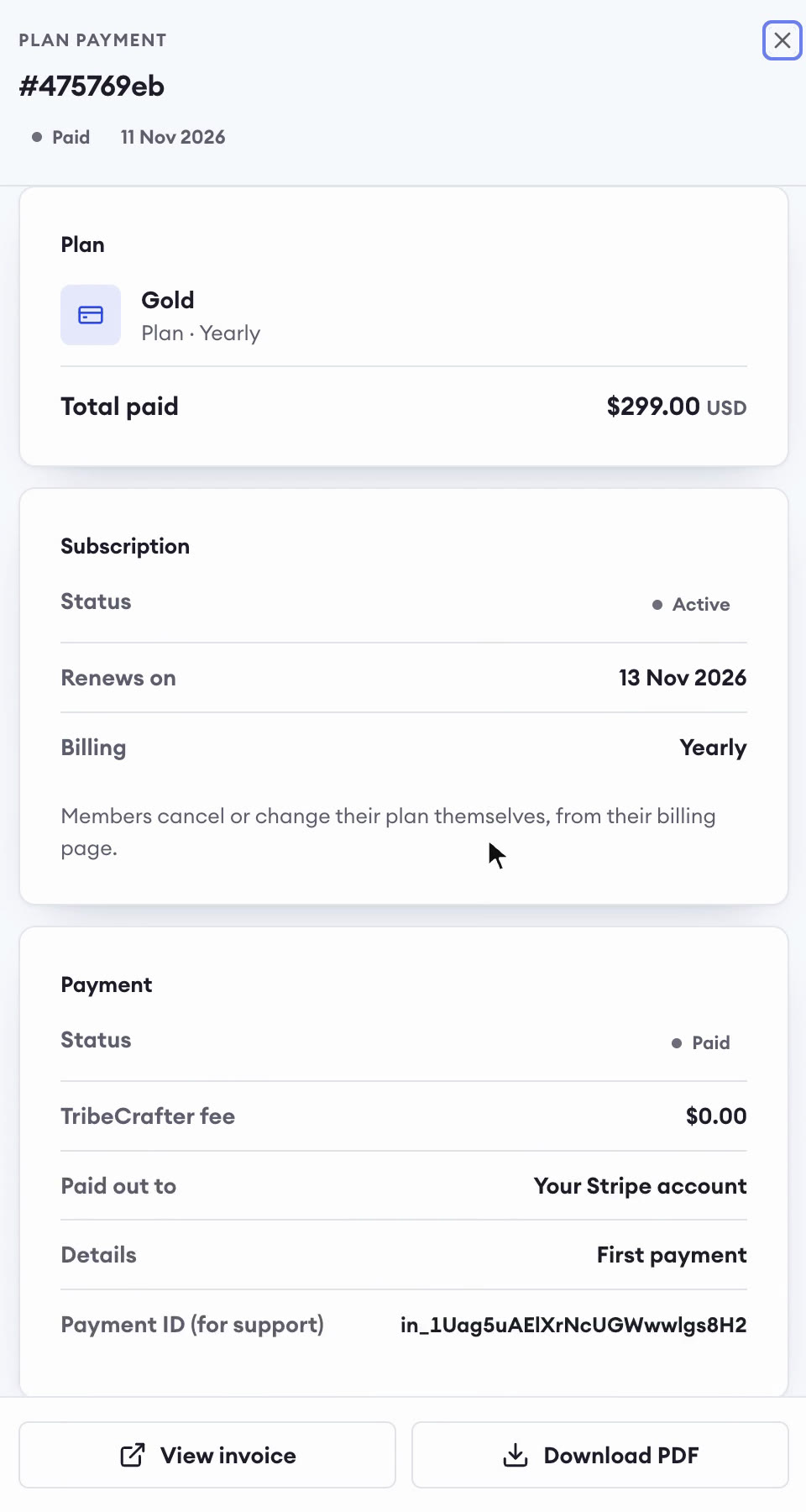
So there's no equivalent of BuddyBoss's Start-plan fee, and no higher plan you need to reach to avoid one. Courses, groups, events and the blog are on every plan too, not gated behind an upgrade.
Switching early? The founding offer gives our first 30 communities the Growth plan at $99/mo for the first year, billed annually ($1,188), instead of $149/mo. After that it renews at the normal Growth price, and we remind you 30 days before. There's no trial on it: claim it straight away, or set it up with the founder on a call first. See the founding offer
14-day free trial, no card, and a 30-day refund on your first payment. Or bring your BuddyBoss invoices to a call and we'll go through them together.
Why BuddyBoss Slows Down as Your Community Grows
WordPress was built to serve blog posts, not to run a live social feed. A community puts a different kind of load on it: feeds refreshing, notifications firing and searches running, all against the same database, for every member, all day. That load grows with the community. Speed is one of the most common complaints you'll find about BuddyBoss.
The usual fix is premium hosting with caching plugins on top. It helps, but it works around the strain rather than removing it. And caching a community is harder than caching a blog, because every member sees a different feed, different notifications and different groups. Much of what a member sees can't simply be served from a cache.
Great Big Photography World is a good example of how far the workarounds go. Before the move, the site was slow even on a dedicated server with 64 GB of RAM. WordPress updates were switched off, because the plugins' licence and update checks slowed the site down. BuddyBoss crashed the site or made it unusable many times. Their team noticed it every day:
WordPress was quite slow, specially the front end… uploading images, loading posts.Irfan Arshad, Content and SEO Manager at Great Big Photography World
TribeCrafter starts from a different place. It was built as a community platform from the first line of code, not a blog with a feed added on. Each community runs on its own database, storage and search, which is why it stays fast and stable as it grows. You don't need a caching plugin to keep up, because there are no plugins at all. On Great Big Photography World's live site, pages load in about 0.75 to 1.2 seconds on desktop in a lab test, with no layout shift.
Speed also changes how members behave. On WordPress, from January to June 2026, an average of 10 members a month posted or commented on Great Big Photography World. On TribeCrafter, in September and October 2026, it was 58 a month, and comments and replies went from 58 a month to 235. Those counts leave staff out and include members who joined after the move, so speed isn't the only reason, but it's part of it.
WordPress Was Never Built to Be a Community Platform
WordPress didn't start out to run communities, or even websites in general. In 2003, Matt Mullenweg and Mike Little forked an abandoned blogging tool called b2/cafelog and built WordPress on top of it. At its core, it's a blogging platform, and a very good one.
Community came later, and it came from outside WordPress itself. In 2008, developer Andy Peatling built BuddyPress as its own project to add social features to a WordPress site. Forums were added the same way, through a separate plugin, bbPress.
BuddyBoss is a further layer on top of that. By BuddyBoss's own account, BuddyBoss Platform is a fork and rebuild of both the BuddyPress and bbPress plugins.
So a BuddyBoss site runs on several generations of software: a blogging tool, a community layer added on, a forum layer added on, and BuddyBoss's own layer on top of that. Then come the course, membership, caching and security plugins. None of it started life as one purpose-built community platform, and you feel the seams every time something breaks or slows down.
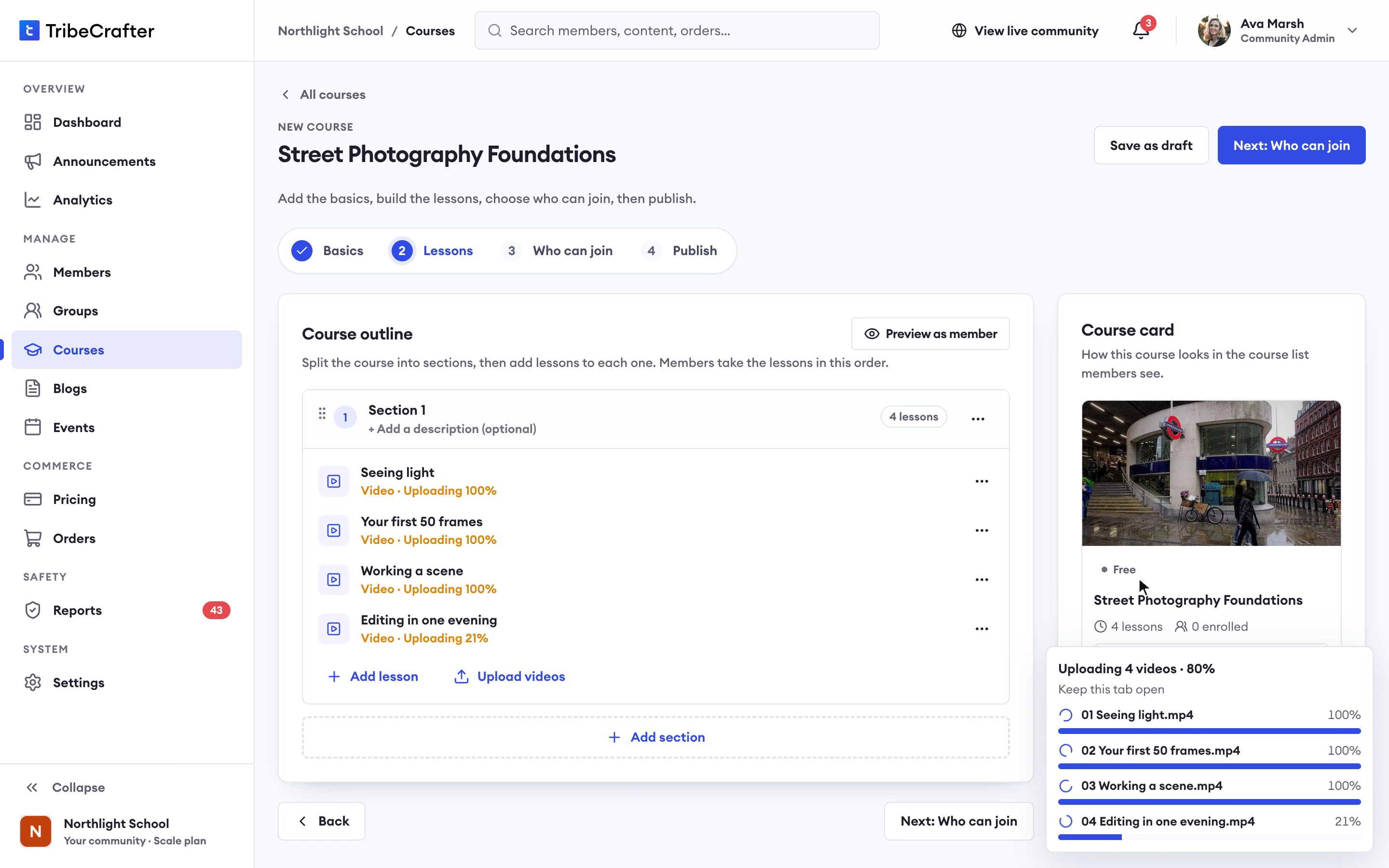
TribeCrafter skips all of that. Courses, groups, events, the blog, the member directory, 1:1 chat and selling are the foundation, built together and run by one team, not features stitched onto a blog. Owners set up and run all of it in Studio, one admin app built for people who aren't technical.
A Note From Our Founder
The Maintenance Burden: Plugins, Updates, and Security
Patching BuddyBoss's code, running it, and still not being able to make it fast points at something bigger than speed. Running a plugin-based platform means owning its upkeep: every plugin in the stack has to stay patched and compatible with every other one. That's the real difference between these two platforms.
Why Plugin-Based Platforms Carry More Risk
WordPress core itself is well maintained. The risk sits almost entirely in the plugin layer. Patchstack's State of WordPress Security in 2026 counted 11,334 new WordPress vulnerabilities in 2025: 91% in plugins, 9% in themes, and just 6 in WordPress core. BuddyBoss ships both a plugin and a theme.
Every plugin you add to run a full community, from the activity feed to courses, forums, payments and the app connection, is another piece of code that needs to stay patched. That's the trade-off that comes with owning and running the stack yourself. Security plugins help, but they're one more plugin to update.
What Happens If You Don't Renew
According to BuddyBoss's own documentation, if your licence lapses, your website keeps running, but you stop getting updates, including security patches, and you lose access to support.
If your app subscription lapses, the app stops working. BuddyBoss also says an expired licence can't simply be reactivated: you buy a new subscription to get updates and support again. Both are worth knowing before you build your budget around a single upfront price.
What TribeCrafter Takes Off Your Plate
On TribeCrafter there are no plugins to update. Updates are ours to test and ship, and if something breaks, it's ours to fix. Hosting and security are ours to run. Files in paid groups and courses open only for members who have access, even if someone shares the direct link. You set up and run everything in Studio.
TribeCrafter vs BuddyBoss: Side-by-Side
TribeCrafter is an all-in-one community platform: groups, courses, events, a blog, a member directory, 1:1 chat and selling in one hosted product. Instead of layering plugins on WordPress, each TribeCrafter community runs on its own database, storage and search, and we run everything around it. Both are real, capable platforms. The difference is how much of the day-to-day work lands on you.
| BuddyBoss | TribeCrafter | |
|---|---|---|
| What it is | A plugin and theme for your own WordPress site | One hosted product |
| Who runs hosting, updates and security | You, or a developer you pay | We do |
| Web plan | $199–349 first year, renews at $399–699 a year; hosting not included | $49–299/mo billed annually, every feature on every plan |
| Free trial | None (14-day money-back guarantee) | 14 days, no card, and a 30-day refund on your first payment |
| Platform fee on your sales | 0% on Launch and Scale; 2.9% on the Start plan | 0% on every plan |
| Courses | Built-in courses, or a LearnDash licence on top | Built in, with hosted video |
| Mobile app | Separate subscription, $499–2,999 first year, renews at $999–3,999 a year | Phone browser today; native apps coming early 2027 |
| Moving your members | n/a | Our team imports them, with no sign-up emails |
| Members' login | n/a | They can keep your WordPress login, set up with our help |
| When something breaks | Theme, plugin and hosting vendors, each separately | The founder answers support himself |
Start a 14-day free trial with no card, or talk the move through with the founder first. 30-day refund on your first payment.
Managed vs. Self-Hosted
With BuddyBoss, you run your own WordPress stack: your own hosting, your own updates, your own security patches. Even on BuddyBoss's Managed app plan, where their team builds and publishes the mobile app for you, the website is still yours to run. "Managed" there covers the app, not the site. Done For You Web covers the site too, at $2,499 a year after the first year.
TribeCrafter takes the simpler route: one managed platform, not a stack you assemble and maintain. There's no plugin ecosystem to keep patched, no server to watch, and no update that might break your feed overnight. Your data still stays separate, with its own database, storage and search, not pooled with everyone else's. But the bigger difference day to day is how much less there is for you to do.
What's Included on Every Plan
BuddyBoss splits features and pricing across its web plans and three separate app plans. On TribeCrafter, every feature is on every plan, from Starter at $49/mo billed annually, with unlimited members. You don't choose a plan to unlock 0% fees or course features. Here's what that covers:
- Feed: posts with polls, reactions and threaded comments, live updates without a refresh, saved posts and pinned posts in groups.
- Groups: free or paid, each with its own feed, members, media and shared files.
- Courses: sections and lessons with hosted video, text and files, free preview lessons, progress and resume, several instructors, and a PDF certificate when a student finishes.
- Events: online or in person, with RSVPs, add to calendar, email and in-app reminders, and a recording link afterwards.
- Blog: public or premium posts, with a block editor, categories and related posts.
- Members: a directory, profiles, follows and connections, and 1:1 chat with files, replies and read receipts.
- Selling: one-time products and monthly or annual plans, bundles and "all courses" offers, Stripe checkout and order history, in your own currency.
- Running it: Studio for content, pricing, members, orders and settings; team roles; a moderation queue for reported posts; your logo, colours, landing page and domain; branded email from your own domain; and one search across members, posts, groups, courses, events and the blog.
See the full feature list for the detail.
Pricing and Fees
TribeCrafter charges 0% platform fees on every plan, including Starter. Nothing comes off the top of what you sell beyond Stripe's normal processing fee, which you'd pay on any platform that uses Stripe. We make money from your plan, not from your sales.
That's a real difference from BuddyBoss's Start plan, where BuddyBoss's 2.9% is added on top of Stripe's fee, and from a membership plugin like MemberPress, whose Launch plan takes 4.9% of payments. On BuddyBoss's Launch and Scale plans, BuddyBoss itself takes nothing, so compare your real, all-in BuddyBoss number, not just the plan price. You can see TribeCrafter's current plans here and try it free for 14 days before you decide.
Making the Switch: What Changes When You Move From BuddyBoss
Switching platforms is a real decision, not something to take lightly. Here's what to expect, part by part.
What Moves Over
We move your members and the content that matters. The move is part of every plan, at no extra cost, and the founder plans it with you before you start. Here's how each part comes across.
- Members and profiles
- Our team imports them for you. No sign-up emails go out.
- Logins
- Members set a password on their first visit. Or they keep signing in with your WordPress login, set up with our help, as long as that site stays up as the place they sign in.
- Paying members
- They keep the access they paid for until their period ends, or for life if they bought lifetime access. At renewal they subscribe on TribeCrafter. The old subscriptions are stopped on WordPress, so nobody pays twice.
- Blog posts
- Moved with our help, with their authors and original dates.
- Old links
- Each old address redirects to its new page, so links from Google and other sites still land in the right place.
- Courses
- You rebuild them in Studio: upload a course's folder of videos and each video becomes a lesson. The founder walks you through it.
- Forums
- Groups take their place, each with its own feed and threaded comments.
- Starts fresh
- Course progress: students start each course at 0%, with progress saved from then on. Private messages and order history stay on WordPress.
No LearnDash courses? Then there's nothing to set up again: we move your members and posts, and you add your plans in Studio.
Your site stays up during the move. Your WordPress site keeps running while we set up TribeCrafter, and you switch over on the day you go live, with one email to your members.
The way you monetize your community, through products and subscriptions, carries over in concept, even though the setup looks different because TribeCrafter isn't built on WordPress. You set up plans and products in one Pricing area in Studio, and a paid group or course needs an offer before it goes live, so nothing gets published that members can't buy.
How the Move Works, Step by Step
- Together: a 30-minute call about what you run today, which plugins, and what moves.
- You, with the founder: your logo, colours, plans and groups in Studio. He walks you through every screen.
- Our team: imports your members, moves your blog posts and points your old links to their new pages.
- You: your courses. Upload each course's folder of videos in Studio and each video becomes a lesson. No code.
- Together: we plan the email to your members, and you go live on your own domain.
The founder's help is guidance, not data entry: he shows you how and answers your questions, and you stay in control of your own content.
2,314 members moved100+ plugins replaced by one product768 blog posts816 old links redirected
Moving Great Big Photography World off WordPress and onto TribeCrafter was a real leap of faith, and we took it gladly. What used to be a patchwork of plugins is now a platform we can grow with.Domien Van Eynde, Founder, Great Big Photography World
I would highly recommend it over WordPress, specifically BuddyBoss.Perrin, Site Admin at Great Big Photography World
Our founder looked after their BuddyBoss site for years. They have been live on TribeCrafter since 1 September 2026.
Keeping members engaged through the move matters as much as the move itself, and the usual member retention basics still apply: tell members early, explain what changes for them, and give them a reason to visit in the first week.
What's Still on TribeCrafter's Roadmap
To be upfront: TribeCrafter doesn't have a native mobile app yet. Members use it in their phone's browser today: the feed, groups, courses, events and chat all work there, with email and in-app notifications. Native iOS and Android apps are coming in early 2027.
If a branded app is a must-have for you right now, weigh it against what BuddyBoss's own app costs: a separate subscription of $499 to $2,999 in the first year, on top of your web plan, with its own jump at renewal.
You can see what we're building on the public roadmap and ask for what you need there.
When BuddyBoss Might Still Be the Right Call
If you're deeply invested in a specific set of WordPress plugins, have in-house technical help, rely on features TribeCrafter doesn't have, such as points and badges, or need a native app today, BuddyBoss can still be the better fit. None of this is a knock on BuddyBoss as a product. It's a mature, capable platform built for a different kind of owner than the one this article is written for. This isn't a one-size-fits-all decision, and growing a community well matters more than which platform it runs on.
On a 30-minute call we look at what you run today, which plugins, and what moves.
Why TribeCrafter, and Why Now
BuddyBoss was acquired in July 2024 by the WPBeginner Growth Fund, which is backed by Awesome Motive, the company behind WPForms, AIOSEO and other WordPress plugins.
TribeCrafter is bootstrapped, with no outside investors, so our roadmap answers to the communities on the platform, not to a portfolio owner. That's not a knock on acquisitions in general. But it's a fair thing to weigh when you're choosing a platform to build a community on for the next several years.
We ship about every one to two weeks, and you can see what's changed in the changelog. Requests go straight to the people who build the product. And when you write to support, the founder answers.
Why now? Because the cost of staying goes up at every renewal, and the move only gets bigger as your community grows. If you're already paying renewal prices, already working around slow pages, or already holding off on updates because you're afraid of what they'll break, that's the moment to look.
Conclusion
BuddyBoss and TribeCrafter solve the same problem in different ways. BuddyBoss means assembling and maintaining a WordPress stack yourself: patching plugins, watching licence renewals, paying for hosting and a developer, and choosing plans carefully to avoid fees. TribeCrafter means one managed platform instead, with courses, events and selling built in, 0% platform fees on every plan, and no plugin stack to maintain.
If the real cost and upkeep of BuddyBoss are what brought you here, it's worth seeing the difference for yourself. TribeCrafter has a 14-day free trial with no card, a 30-day refund on your first payment, and moving your members is part of every plan.
Explore TribeCrafter's plans, read the BuddyBoss alternative overview if you want the short version, or talk it through with the founder.
Quick Takeaways
- BuddyBoss means running plugins from many vendors, where any update can break a feature and no single vendor owns the fix.
- BuddyBoss's first-year price isn't what you pay after: Launch goes from $199 to $399 and Scale from $349 to $699 at renewal.
- On BuddyBoss's Start plan, BuddyBoss takes 2.9% of sales through its own Memberships and Courses, on top of Stripe's fee. Launch and Scale take nothing.
- The mobile app is a separate subscription: $499 to $2,999 in the first year, renewing at $999 to $3,999 a year.
- BuddyBoss's own plans come to about $1,400 to $4,700 a year at renewal. A Launch web plan with a one-store app, LearnDash and some developer help is about $2,150 a year before hosting.
- WordPress was built for blogs, and a BuddyBoss site is several layers of plugins on top of it. Patchstack found 91% of new WordPress vulnerabilities in 2025 were in plugins.
- TribeCrafter's founder spent years keeping a large BuddyBoss community, Great Big Photography World, fast and online, including fixing BuddyBoss's own plugin code, and still couldn't make it feel fast. That's why TribeCrafter was built from scratch.
- Great Big Photography World moved over with 2,314 members, 768 blog posts and 816 redirected links, and replaced 100+ plugins with one product.
- On TribeCrafter, every feature is on every plan from $49/mo billed annually, with unlimited members, 0% platform fees and no plugins to update.
- Our team moves your members as part of every plan, and members can keep your WordPress login. Native apps are coming early 2027.
- BuddyBoss was acquired in 2024 by a fund backed by Awesome Motive; TribeCrafter is bootstrapped, with no outside investors.
- All prices here are a snapshot from November 2026. Check each company's pricing page before you decide.
FAQs
Is BuddyBoss worth it?
It can be, for technical owners who already know WordPress, want deep control over their site and are happy to run their own stack. It's a mature, capable platform with a long track record. It's harder to justify for owners who aren't technical and want to launch and grow without becoming their own IT department, or who don't want to work out which plan avoids fees. Weigh the real cost and upkeep, covered above, before you commit.
How much does BuddyBoss actually cost per year?
It depends on the plans you choose and what you add around them. The Launch web plan is $199 in the first year and renews at $399; Scale is $349, renewing at $699. The app adds $499 to $2,999 in its first year and $999 to $3,999 a year at renewal. BuddyBoss's own plans alone come to about $1,400 to $4,700 a year once renewal pricing applies. With a course plugin and some developer help, a Launch web plan plus a one-store app is about $2,150 a year before hosting; see the sums. Prices were checked on 13 November 2026.
Is BuddyBoss a fork of BuddyPress?
Yes. By BuddyBoss's own account, BuddyBoss Platform is a fork and rebuild of the BuddyPress and bbPress plugins. BuddyPress itself began in 2008 as Andy Peatling's own project, and WordPress began in 2003 as a fork of an earlier blogging tool, b2/cafelog. So a BuddyBoss site runs on several layers of software on top of a tool that started out as a blog.
Why does BuddyBoss feel slow?
It runs a live feed, notifications and search on WordPress, which was built to serve blog posts, not live community activity. That load grows with the community, which is why premium hosting and caching often become necessary, and why speed is one of the most common complaints about BuddyBoss.
Who owns BuddyBoss?
The WPBeginner Growth Fund, an investment fund backed by Awesome Motive, acquired it in July 2024. Awesome Motive is the company behind WPForms, AIOSEO and other WordPress plugins. TribeCrafter, by contrast, is bootstrapped with no outside investors.
How much does TribeCrafter cost?
Billed annually, Starter is $49/mo, Growth $149/mo and Scale $299/mo, with a custom Enterprise plan above that. Every plan has every feature, unlimited members and 0% platform fees; plans differ by storage, team seats and video. There's no separate course plugin or hosting bill. You still pay Stripe's normal fee on each sale. Switching early? Ask about the founding offer: Growth at $99/mo for the first year, billed annually, for our first 30 communities; see the plans.
Does BuddyBoss have a free plan?
Sort of. The core BuddyBoss Platform plugin is free and open source, but the BuddyBoss Theme, the integrations and support come with the paid plans, from $199 for the first year. There's no free trial of the paid plans, though BuddyBoss offers a 14-day money-back guarantee.
Does TribeCrafter offer a free trial?
Yes. Starter, Growth and Scale come with a 14-day free trial and no card, so you can try courses, groups, events and selling before you pay. If you do pay, you can ask for a full refund within 30 days of your first payment. The founding offer has no trial.
Can I use BuddyBoss without WordPress?
No. BuddyBoss is a WordPress plugin and theme, so it needs a WordPress site to run. TribeCrafter runs on its own, with nothing to install.
Does BuddyBoss's mobile app cost extra?
Yes, and it has three plans of its own. Solo (one store) is $499 for the first year, renewing at $999. App Launch (both stores) is $999, renewing at $1,999. Managed (built and published for you) is $2,999, renewing at $3,999. You also need your own Apple ($99 a year) and Google ($25 once) developer accounts. If the app subscription lapses, the app stops working, even if your website keeps running.
Does BuddyBoss charge transaction fees?
Only on the Start plan. There, BuddyBoss takes 2.9% of sales made through its own Memberships and Courses, on top of Stripe's fee; with Stripe's standard US card fee, that's about 5.8% + 30¢ a sale. On Launch and Scale it takes nothing, and it never takes a cut of sales through plugins like LearnDash or MemberPress, though those are separate paid licences.
What happens if my BuddyBoss licence expires?
Your website keeps running, but you lose updates, security patches and support. If the app subscription lapses, the app stops working. An expired licence can't be reactivated; you buy a new subscription to get updates and support back.
Can I migrate my existing BuddyBoss community to TribeCrafter?
Yes, at no extra cost: the move is part of every plan. Our team imports your members and profiles without sending sign-up emails, and moves your blog posts and old links. Paying members keep the access they paid for. You rebuild your courses in Studio from folders of videos, with the founder walking you through it. Course progress starts fresh; see what moves.
Do my members have to sign up again?
No. We import their accounts and they set a password on their first visit, or they keep signing in with your WordPress login, set up with our help, while that site stays up.
Is TribeCrafter built on WordPress?
No. It's its own hosted platform, with nothing to install or self-host. Each community runs on its own database, storage and search, and there are no plugins.
Does TribeCrafter charge transaction fees?
No. TribeCrafter takes 0% of your sales on every plan, including Starter, whether you sell one-time products or subscriptions. You pay only Stripe's normal fee, and payouts go to your own Stripe account.
Does TribeCrafter have a mobile app?
Not yet. TribeCrafter works in any phone's browser today, and native iOS and Android apps are coming in early 2027. If a branded app is essential right now, factor that in, along with what BuddyBoss's own app costs.